When wkrm conducted its initial research, we found several key data points related to the attitudes and actions towards design:
Students are unsure about what they have access to.
With confusing policies and lack of information in the environment, students don’t know who to turn to when they need help or information, nor is there a central place for information.
Students that need to do 3D projects have difficulty accessing AHG/Labs on short notice.
The student mindset is usually one of being a procrasinator. While perhaps this isn’t the most ideal condition, it’s one that a space may need to be designed for, or perhaps designed to prevent by providing access to critical information to enable students to better plan and prepare for situations to avoid last minute scenarios.
The only resources not behind a locked door are power outlets.
Most resources were locked behind an ID scanner that students didn’t have access to, or tucked away in a locked room or classroom studio that students weren’t aware that they could access. For instance, the “protocarts”–which held prototyping materials, were stored in the classroom, implying that they were for use by certain classes during designated class times.
Students don’t know when classes are in/out of session, so they struggle to use classrooms for study and projects.
Given the limited space in the commons and the way noise travels, students lacked critical information of when a class was in session, leading to doubts if they could or couldn’t use certain spaces in AHG.
Given the range of the types of “design” the department offers, AHG would have to account for not just the majority, but all types of design. This leaves a discrepancy on how to design AHG in a way to help accommodate for all of these types of design, but also how to incorporate all of these design mediums in a way that enables students to use AHG as a resource vs just another space on campus.
In the Fall 2023 Climate Survey, students were asked questions related to the environment that AHG affords and if that enables them to get design-related work done:
What medium of design do you feel like you produce the most of? 62 responses
47 people responded that "Graphic, 2D-based mediums", which was 76% of respondents.
4 people responded that "Industrial, 3D-based mediums", which was 6% of respondents.
5 people responded that "Design Research and Design Thinking", which was 8% of respondents.
0 people responded that "Design History/Theory/Analysis", which was 0% of respondents.
From the following reasons, select the primary reason that you go to Anna Hiss Gym
51 responses
23 people responded that "I go to Anna Hiss Gym because two or more of my classes are there", which was 45% of respondents.
17 people responded that "I go to Anna Hiss Gym because one of my classes is there", which was 33% of respondents.
2 people responded that "I go to Anna Hiss Gym because of the collaborative workspaces and tools available to get work done", which was 4% of respondents.
0 people responded that "I go to Anna Hiss Gym because they offer compelling services, like the critique station and rooms that can be reserved for collaborative work", which was 0% of respondents.
2 people responded that "I go to Anna Hiss Gym because it’s a space that design calls home, and I feel like I own it", which was 4% of respondents.
7 people responded that "I currently don’t go to Anna Hiss Gym", which was 14% of respondents.
34 people responded that "Yes, I have two or more classes in ART/DFA.", which was 65% of respondents.
13 people responded that "Yes, I have one class in ART/DFA.", which was 25% of respondents.
5 people responded that "No, all of my classes are in AHG.", which was 10% of respondents.
A follow-up question was asked for those who used AHG: why do you choose to stay or flee, and how do you use the space now:
I appreciate the amount of work space as well as the number of outlets everywhere. I also miss having the option to print in the AHG.
No printer, wish there were more supplies/tools to create with in the main area.
There’s a lot of space so I feel like I could stay, the furniture is also nice. However there is no food near to stay long periods unless I bring something myself.
I like the private rooms but wish that the common areas felt cozier and more comfortable.
I don’t stay...seating is uncomfortable and too lounge-like...it still needs to be functional for me to do computer work and/or eat a meal.. Even if the lights were a bit dimmer,
it’d help the building feel less like a storage unit or a warehouse.
(There is a) lack of outlets, info on when/where things in the common space are reserved.
These insights from students revealed that AHG succeeds in specific niches of design, but doesn’t represent all the mediums of design. Each student described different situations on how they work and where they work, and while accommodating for all of their work styles may be infeasible, a redesign of AHG could consider different configurations for different work styles.
As part of my research to understand the attitudes and attributes towards design, I visited different design studios around Austin to better understand what design looks and feels like, and how that could be replicated and used as a basis in AHG. By understanding how each studio creates a space centered around design, perhaps those principles could be replicated and customized in the vision plan for AHG.
Jamie Turner Design
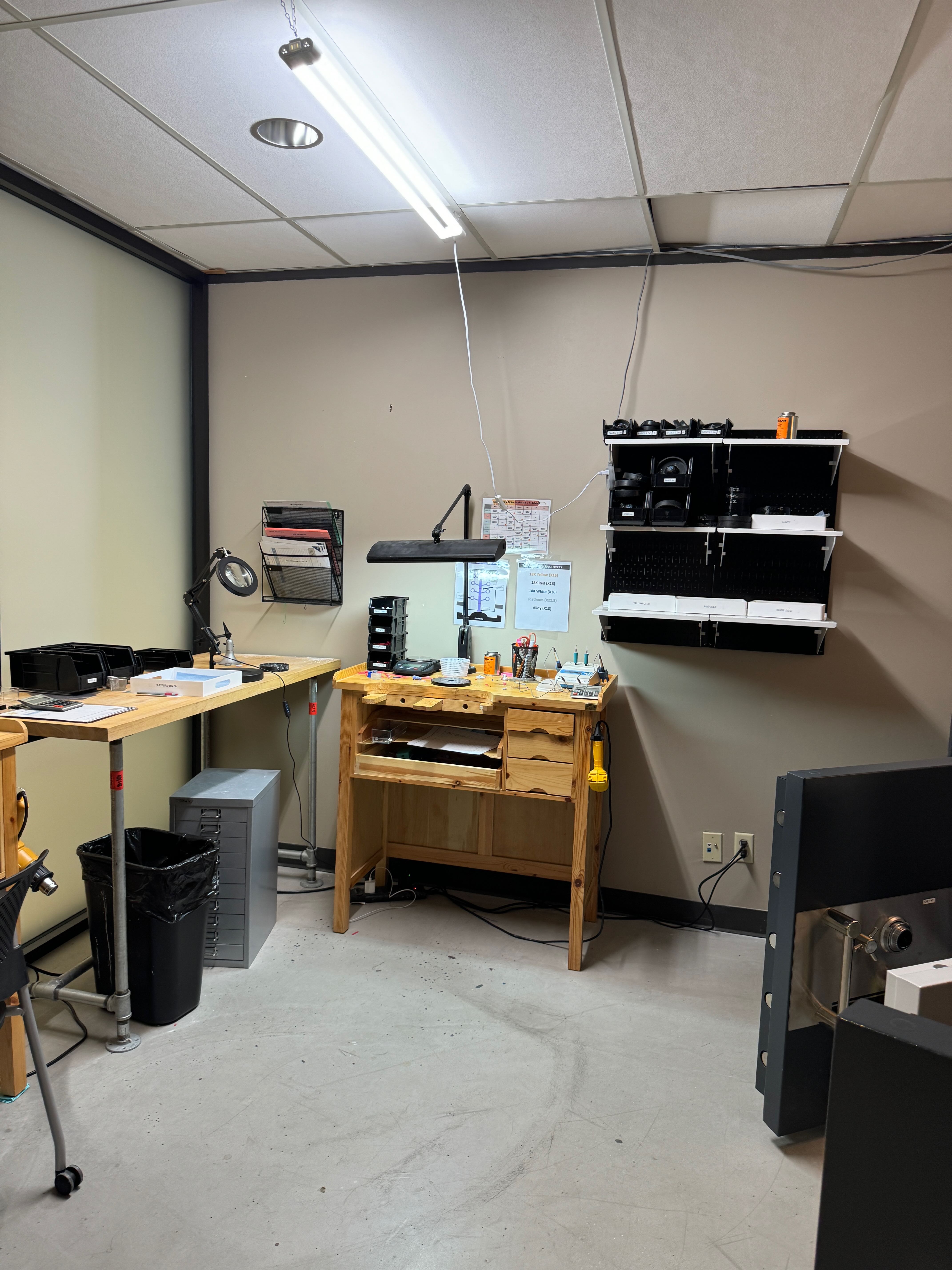
Jamie Turner Designs is a jewelry studio in Austin Texas. All pieces that they made are designed and manufactured in-house. Their studio, located in Westlake Hills, is within a small office complex. Given their tight and small space, it was interesting to see and understand how they did their work and to better understand how efficient they were in their processes and procedures.
What we learned
Visiting their space led to three distinct takeaways that factored into the future vision of AHG:
Ergonomics
The space was designed in such a way that supported the work they did. In the main jeweler area, they had ground pieces to enable movement and standing, which led to more efficiency for the people in the space. Looking at AHG, you can make the tables rise to use at a standing desk, but standing on the concrete for hours at a time may be unconformable.
Triangulation
Triangulation is best described as being one with the space. Essentially, it’s bringing resources together in one cohesive area to support work. In the case of Jamie Turner, the co-owner Patrick custom-designed pieces to better support the work of his employees–and he’s working on building a custom desk for his designers and jewelers to sit at. Having different desks and configurations of work for design students to use may encourage them to stay and feel like they are well-supported at AHG.
Welcoming
From the visitor's perspective, walking into the space felt like we were walking into someone’s home. The space didn’t feel like there were, essentially, any offices or spaces people called “their own”–sort of like AHG. In turn, though, the furniture and “thoughtful messes” really made the space feel like a design space and felt crafted in such a way that encouraged people to be productive and work on their designs.
Asterisk Design
Asterisk Design is a design studio in Austin Texas. Their primary focus is on service-based design, which includes creating brands and integrating that into the environment via environmental graphics and signage.
What we learned
Visiting their space led to three distinct takeaways that factored into the future vision of AHG:
Collaboration
Given the small space, the desks and workstations were arranged in way to both facilitate privacy, yet allow for collaboration and communication given their arrangement. It was cool to see how members of the studio were able to break into their own work, yet feel like they weren’t alone and could ask each other for advice. They also talked about this idea of having privacy through the power of headphones, which allows designers to go heads down in a collaborative space.
Openness
The co-principals, Susanne and Shawn Harrington, described one of their core values that designers shouldn’t always have their headphones on, and should always be listening to their surroundings, that’s when ideas happen. They recalled an example of an in-studio critique, where some members of the firm would listen in and note down feedback from the clients to better prepare and understand the needs to adapt their designs. This idea is something that not only should be considered as part of AHG’s design, but also a deeper question of the department’s pedagogy.
Space
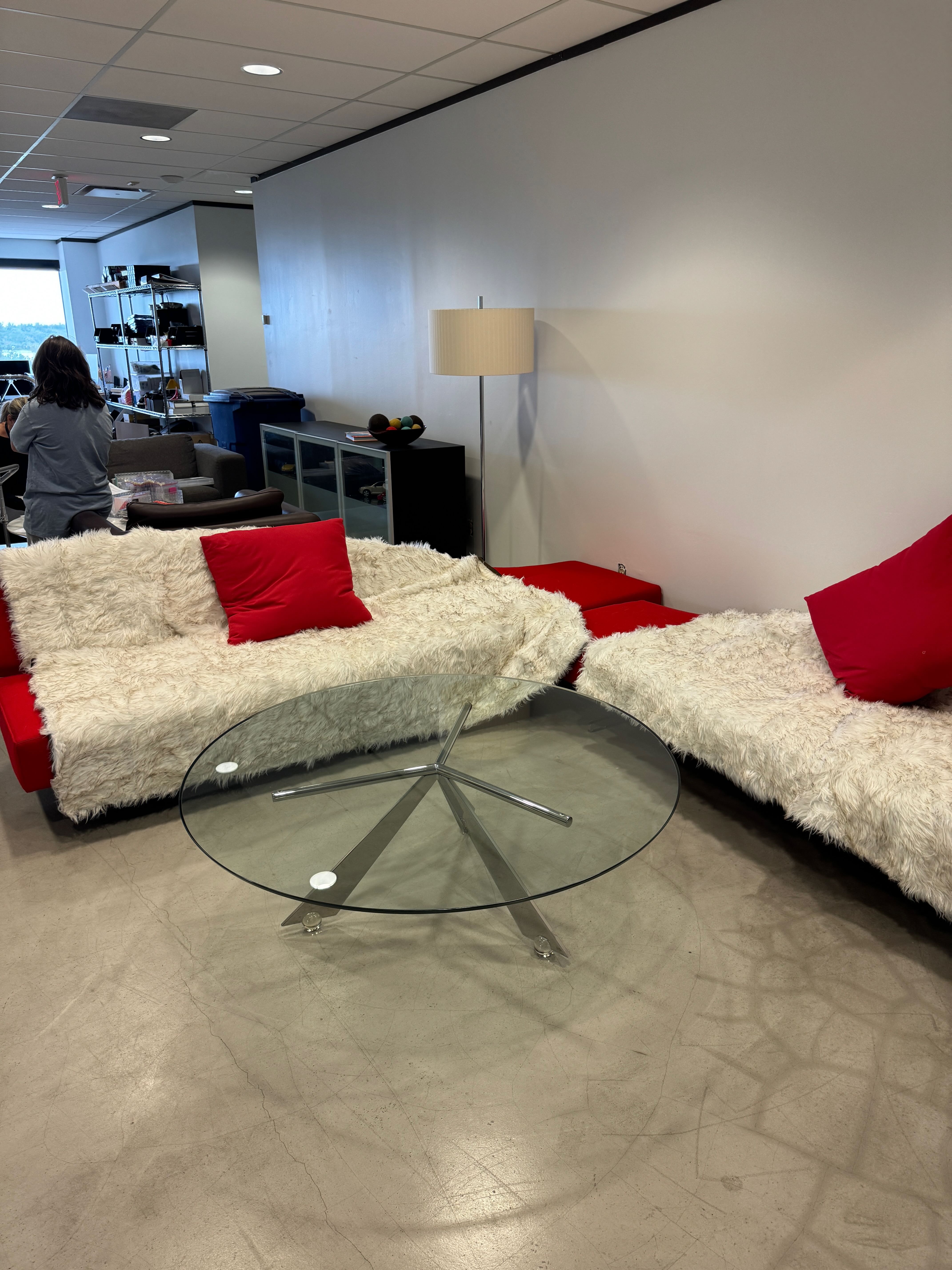
Susanne and Shawn both described how old fashion they were. When we walked into the space, we saw work hanging up post-review, which made the space feel alive and like progress was being made and happening. Work was left up for review and not taken down. It was easy to refer to critique and other elements of a project while it was in progress.
HEB Digital
HEB Digital is HEB's digital design divison. Headquarted in East Austin, their studio space is a repurposed space aimed to provide flexibility and opportunities for the whole digital team and to allow breakout sessions where needed.
HEB Digital
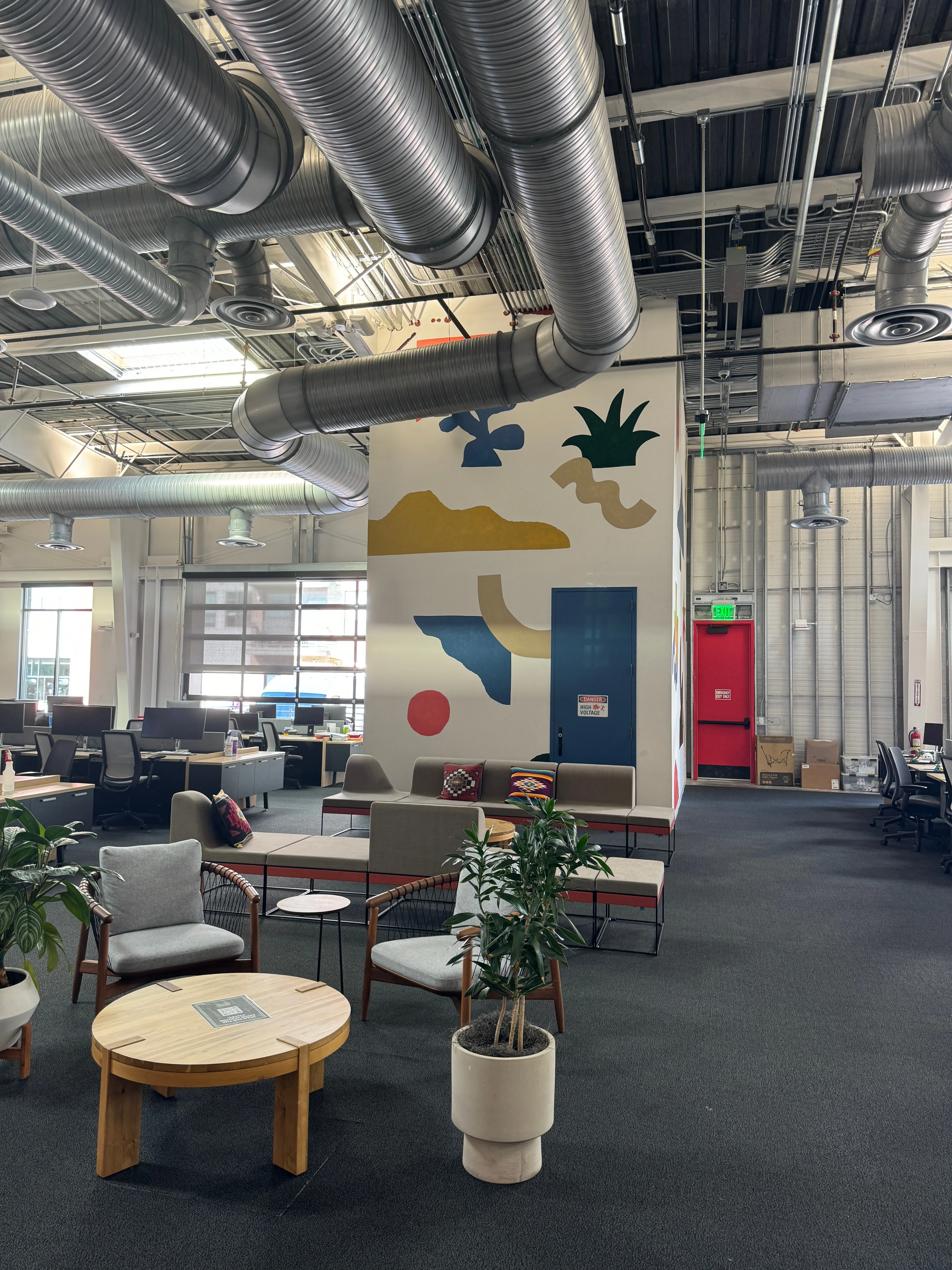
HEB Digital is a studio that houses HEB’s digital operations, including Favor and their web offerings. This space is a newer space that was originally a recycling plant that was re-purposed into the new dedicated digital studio for HEB.
Below are the observations I noticed when visiting the space:
Choice
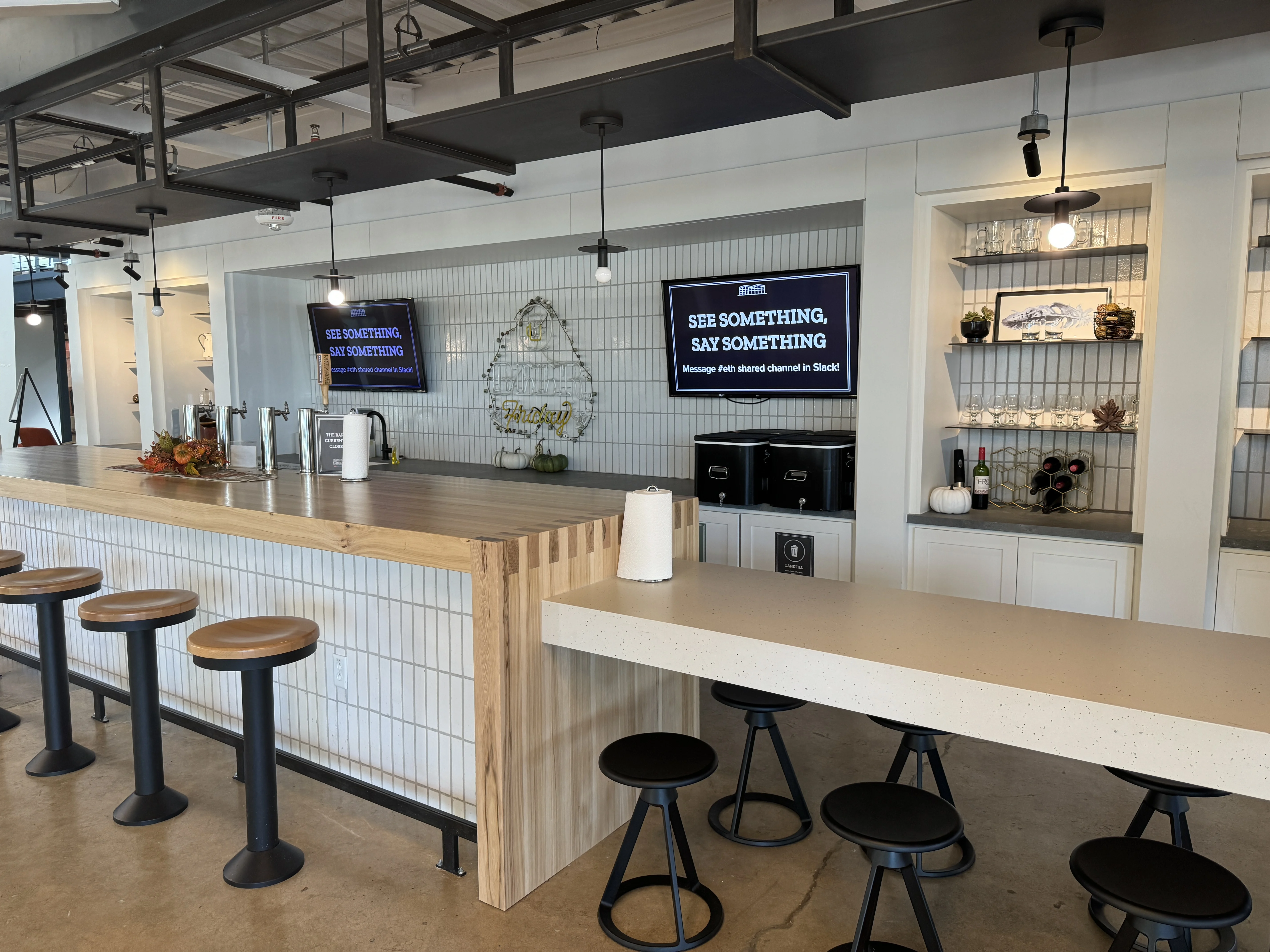
People had an open choice on where they could work. The main halls housed cubical-like desks that allowed for working at a typical monitor setup, but there were also spaces, like a “dining hall”-like setup, along with hightop seating that people could choose.
Openness
The space featured wide, open spaces that were closed off by natural barriers. The way the ceiling helped indicate open spaces helped designate whether the space was a private space, or a general open workspace.
Charm
When you walked into the space, you KNEW HEB owned it. The personality was in the artwork, room names, decals, and the space was intentionally designed around Texas. As you moved to the west side of the building, you could see how West Texas was represented, or as you moved to the east, you could notice a boardwalk-like vibe with wooden planks and other features that helped signal or remind folks of the Texas coastline. The personality and intentionality was truly shown through how the body language of the space was exemplified.